Case study
How Moliera2 mapped its whole e-commerce division into Asana and cut unnecessary work

Moliera2 is a boutique offering exclusive collections of clothing, footwear, and accessories from luxury brands, curated by top designers from around the world. With seven showrooms across various Polish cities and an online store, Moliera2 has been delivering a premium fashion experience for over a decade, defining not just a style of dress but a way of life
Toolkit used in the transformation
-
Asana
work & project management app
-
Salesforce
CRM
-
Google Drive
file storage
-
Miro
work management application

Before
- High operational costs due to increased “work about work’ and inconsistent use of tools.
- Imprecise prioritization caused by a lack of high-level project visibility and workload management.
- Low consistency in activities due to a lack of clarity on shared goals and others’ actions.
- Stagnation in division development due to chaotic daily operations and a lack of shared guidelines.
After
- Reduced level of pressure, irritation, work-related difficulties.
- Increased productivity (achieved results over a period of time) of each participant, allowing more projects and operations to be carried out at the same time.
- All processes of individual teams and projects in the E-commerce division mapped and transferred to Asana.
- Reproduced structure of the E-commerce division in Asana.
- Clear understanding of division responsibilities in Asana, with prioritized tasks and deadlines clearly defined.
Introduction
Challenge
The leadership team recognized the need to change their approach in response to the performance and management challenges facing the organization’s team members and external contractors.
Operational complexity without proper tools, and high workloads for each team member, combined with a lack of unified project views, led to inconsistent operations and increased operational costs. Additionally, reliance on email communication became a bottleneck, hindering the business’s growth.
Recognizing these obstacles and how they were slowing down the business and destabilizing work, management proactively sought a stable and scalable platform to manage work more effectively.
The goal – to improve communication within the e-commerce department and between other teams at Moliera2.
The decision marked the beginning of a transformational journey to streamline operations and improve team synergy.
The implementation plan was estimated to take approximately 3 months:

6 steps to implement Asana in e-commerce division
The transformation has been divided into 6 stages.
Strategy and audit
Go toMapping and implementing the organization’s structure.
Go toImplementing team and inter-team processes.
Go toBuilding team conventions.
Go toConsolidation of changes
Go toSummary + sustainability of changes measurement
Go to
Stage 1
Strategy and audit
From the beginning, the Moliera2 team had a the Moliera2 team had a clear understanding of its business environment and the areas needing transformation:
- which processes to transfer to Asana.
- what types of projects to include.
The organization’s management highlighter the habits that were blocking communication both within the e-commerce team and between other teams.
Our job was to review the expectations, current e-commerce division strategies and implementation contexts of Asana. So we gathered and structured the client’s requirements, both business and technical.
Together with the client, we analyzed current processes and challenges to create a detailed plan for implementing the project management platform. We addressed any unclear areas with in-depth questions to ensure a smooth transition.
Stage 2
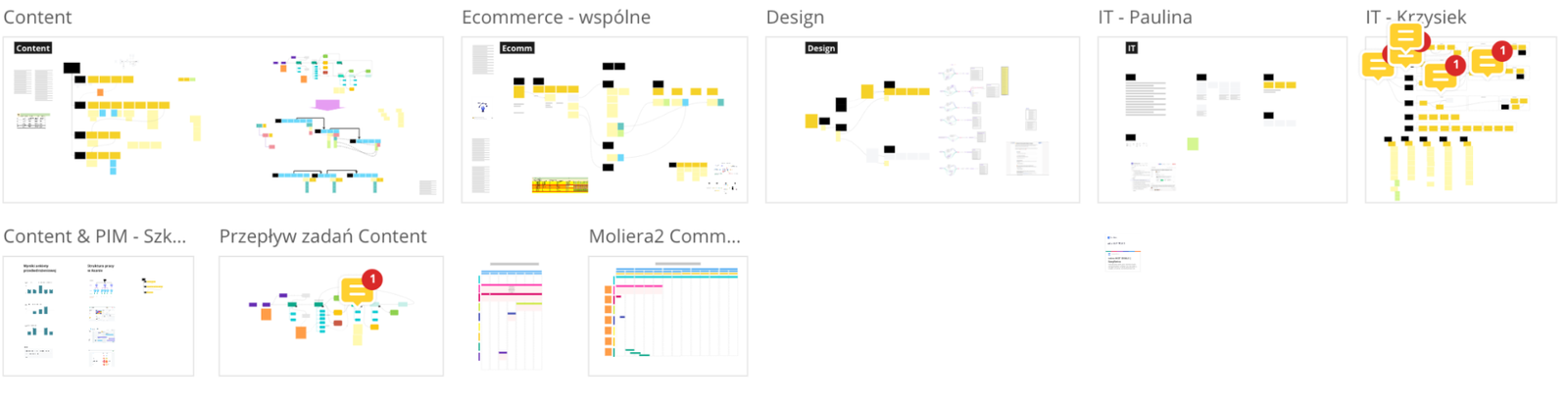
Mapping the structure of the organization
This stage began with a common understanding and clarity about the goals of the implementation and its possible timeline.
It was crucial to involve Moliera2’s leaders in reviewing and breaking down each process to be included in Asana. We developed a mapping and implementation plan aligned with business goals and ongoing operations, ensuring the transformation process didn’t overwhelm participants. Leaders were provided with a process brief to complete as a prelude to the first meeting.
The next step was introducing project participants to Asana and mapping the entire structure of the e-commerce division, including teams, projects, and their interdependencies, based on client data. Together with the leaders, we established metrics to measure the effectiveness of the transformation.
At this stage, we also formed the Asana Alliance among the organization’s leaders. The involvement of key stakeholders was critical to the project’s success, and in Moliera2’s case, their engagement was strong.
Stage 3
Implementing team and cross-team processes
After understanding how and where work is created, we transferred selected processes to Asana.
At this stage, division members fully learned Asana’s functionality and gained proficiency in using this work management platform.
Throughout the project, leaders had unlimited access to a coach, allowing them to schedule appointments at their convenience.
Process Guardians provided existing RACI process maps and tables, which we transferred to Asana and converted into automated workflows. The workflow mapping workshop equipped change leaders with the skills necessary to create processes independently in Asana, without needing further support from Remote Sensei experts.
To ensure the project ran smoothly, we held weekly status meetings to discuss progress and address any issues that arose.
By the end of this phase, we had implemented over a dozen processes across four teams.
As a result, all team members understood how their work impacts others and gained a clear view of the processes they’re involved in, fostering a sense of responsibility for their actions.
However, to solidify these new practices, it wasn’t enough to learn process mapping and translate it into Asana. It was also essential to permanently change habits and behaviors, which we addressed with the client in Stage 4.
Stage 4
Building team conventions
The fourth stage of the transformation focused on developing effective working habits with Asana to unlock the tool’s full potential. These conventions strengthened new collaboration strategies, setting the foundation for the organization’s long-term growth.
Adopting effective practices for using Asana at the individual, team, and management levels is crucial for sustaining the transformation’s results.
Team or organizational conventions serve as a common language across the organization. Just as communication breaks down when people speak different languages, inconsistent use of collaboration tools like Asana can slow down or even block communication. To address this, we worked with transformation participants to introduce simple, easy-to-apply rules that standardized communication and collaboration.
Each convention agreed upon was tested over a two-week period, allowing participants to provide feedback on its usefulness and the benefits it brought.
Implementing these best practices for cooperation and communication also involved retrospective meetings, where participants shared their experiences with specific conventions and made adjustments as needed.
Step 5
Consolidation of changes
In the next step, we proactively monitored the progress of the changes during the first weeks of Asana’s full implementation.
We revisited the metrics established at the start to measure the effectiveness of the implementation. Leaders focused on reinforcing the new cooperation practices: adjusting old habits to match the new methods and addressing any concerns or doubts from team members about how to work effectively.
As part of this stage, participants were asked to record screencasts of their work in Asana, which we reviewed to identify any areas needing further attention.
The key to the success of this stage was the Moliera2 leaders’ commitment to their roles in the Asana Alliance, guiding other members of the organization and upholding the newly developed conventions for working in Asana.
Stage 6
Summary + sustainability of changes measurement
To summarize the project, we designed a debriefing survey to thoroughly assess the implementation’s outcomes. More importantly, the visualization of qualitative and quantitative data highlighted the significant progress made by both the transformation participants and Moliera2 leaders. The survey results also enabled us to provide targeted recommendations for further development of the working methodology in the coming months.
Result
As a result of the transformation, the client’s e-commerce division significantly increased its work efficiency. The implementation of clear team and project structures, along with consistent management processes, enabled better management of tasks and priorities. By setting team conventions and consistently monitoring progress, the changes were reinforced, creating new habits of cooperation and communication.
The result is a more cohesive and effective e-commerce division, now better equipped to collaborate seamlessly with other teams at Moliera2, inspiring similar changes across other departments.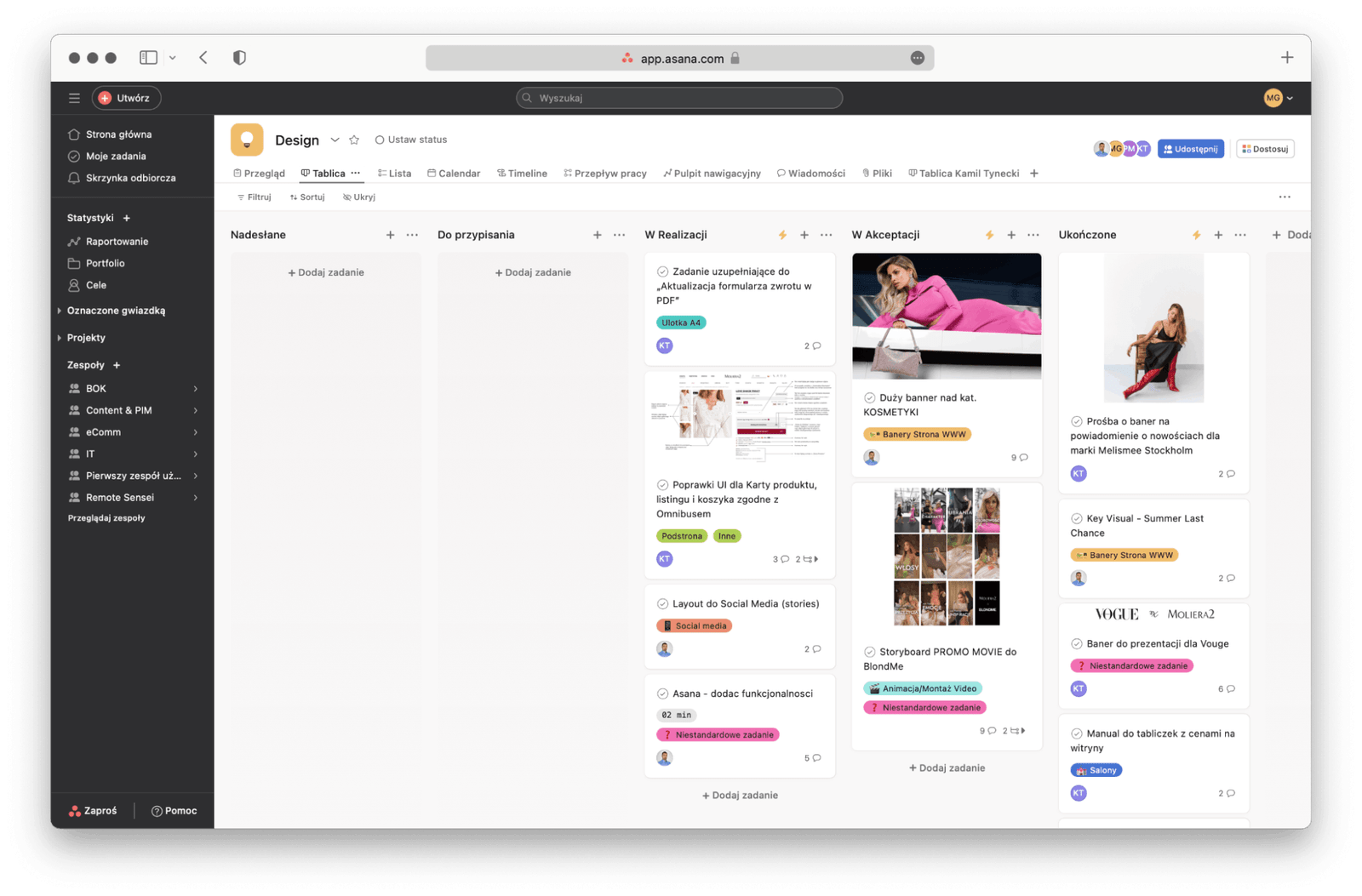
In the post-implementation survey, transformation participants noted:
- Outsourced tasks completed on time, with clear understanding of the scope, timeliness, and responsibilities of each participant as a direct result of the transformation
- Order and visualization of workflows/tasks across the organization, creating a transparent workspace with a clear view and status of all projects – achieved 100%
- Improved information flow within tasks – achieved 100%
- Positive impact on both the team and the organization as a whole
- Full readiness to work and communicate in asana, following the established conventions and the structure of the transferred processes
- Reduced levels of perceived pressure, irritation, and work-related difficulties
- Increased productivity, allowing participants to handle more projects and operations simultaneously
- Clear understanding of responsibilities in asana and awareness of priorities and deadlines
Moliera2 managers confirmed:
- Increased employee engagement and operational efficiency
- Significant reduction in operating costs after eliminating “Work about work” and suboptimal operating strategies in the digital environment
- Readiness to implement structured departmental projects in accordance with best practices and the audit outcomes
- Increased on-time deliverability
Ready to become the next success story?
Every transformation starts by knowing where you are. Choose the path that suits you best:
Need a change management and Asana expert to guide the way?
Live sessions with seasoned business coach
Yes, lets book my free auditFeel confident going solo?
Download our self-guided audit toolkit
I'll lead my own audit