Case study
How Grecos replaced department silos with clear ownership across Poland and Greece, thanks to Asana
 Claude
 ChatGPT
 Gemini
Grecos
is the leader among many tour operators, with prestigious awards won every year. It is a strong brand that has already delivered 18 seasons of priceless experiences to its customers.
Toolkit
-
Asana
work management application
-
Microsoft Sharepoint
file storage

Before
- There were communication silos between the departments
- The company’s goals were not always aligned with individual departments
- Responsibility for the tasks was unclear
- Team members could not keep up with the changing roles because of the rapid growth of the company
After
- Transparent communication made goals known and clear for the whole organization, where everyone knows what to do and who is responsible for what without constant micromanagement
- The client issues are solved faster
- Excursions that include multiple elements to synchronize (hotels, flights, staffing, local events, etc.) are much less stressful to put together
- There is a feeling of alignment between team members
Introduction
The problem
Over the years, the company has transformed its structure many times during the scaling period and mergers of companies. As a result, communication became very complex. Eventually, that led to information silos and misalignment between the goals of each team and the board of directors.
Fortunately, the Grecos leadership had a very agile and modern approach to implementing changes and introducing new tools.
At some point, the CEO realized that the current approach to collaboration was no longer working. He understood that what took him from point A → B (small teams using older-generation communication tools & email) was not enough to get him forward from point B → C (informed, large departments with a common goal clear to all members).
The approach
The transformation was divided into 3 stages
Introducing an interdisciplinary process
Go toCompany-wide audit
Go toImplementation of basic work management tactics in Asana
Go to
Stage 1
Introducing an interdisciplinary process
Before going all-in with Asana, the CEO decided to run a test
He wanted to check how this work management tool would handle a process that involved almost every department
That allowed every engaged member to understand:
- How to interact with each other using the new tool
- How to exchange information and integrate all communication in a new environment
- What are best practices in that process and general project management
- How to avoid common pitfalls when using Asana
This stage consisted of 3 steps
01. Modeling the process in the RACI matrix
A RACI matrix is the simplest, most effective means for defining and documenting project roles and responsibilities. Knowing exactly who is responsible, who is accountable, who needs to be consulted, and who must be kept informed at every step will significantly improve your chances of project success.
As the members of the process were unfamiliar with Asana at this point, modeling was done in Microsoft Excel spreadsheets.
It became a bridge between the old toolbox and changes about to happen
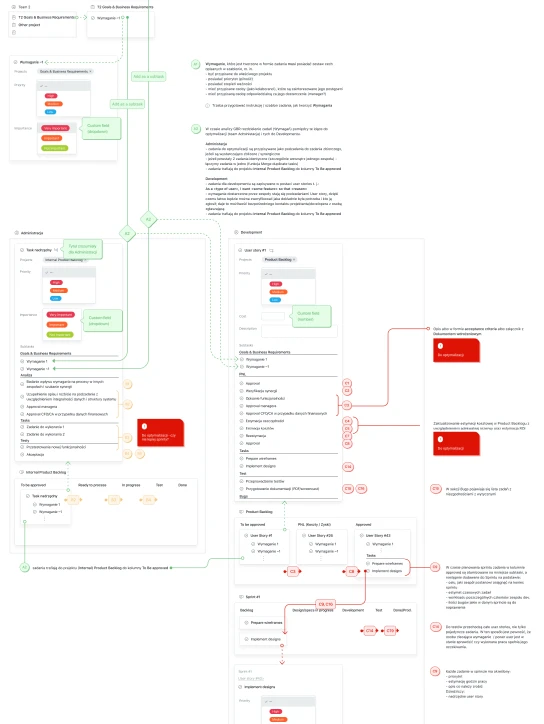
02. Mapping and adjusting the process to the Asana environment
Together with the management team and IT department, we focused on increasing communication efficiency, reducing unnecessary actions, and optimizing information shared between the right people with few clicks.
03. Implementation of the process in Asana
Now, the model became fully executable by implementing the whole workflow into the Asana information architecture.
During implementation, we reached several goals:
- The interface of Asana was uniquely tailored for each participant and role (managers’ high-level view vs. executor/creator view)
- All members were onboarded to an environment with the appropriate teams, projects, and templates available to use by external contractors and process members inside the organization
- The process was ready to be followed immediately after we finished this step
The result of this test
With such an agile approach, the CEO had a much easier decision to make, whether to introduce Asana to the whole organization or not.
People involved in this process became ambassadors in their teams in the following stages of the transformation: a company-wide audit and implementation of basic work management tactics in Asana.
Stage 2
Company-wide audit
Thanks to the growth mindset, the CEO of Grecos was open to hearing honest feedback from his employees
With that attitude, we had complete freedom in unveiling the real reasons for information silos and eventual roadblocks during the implementation of Asana.
We dug deep into each employee’s problems with a handful of questions. Answering them meant letting go of the ego at times but eventually giving a complete picture of the organization’s roadblocks.
We asked questions like:
- What’s the biggest inhibitor to company (or division) growth?
- What do you see as an obstacle on the road to implementing a better solution?
- Along with a follow-up question: why has a better solution not been implemented yet?
- What values drive this company forward, and how often are they discussed?
- What day-to-day things happen here that are indicators of those values?
- Are people accountable, and do they keep their promises and commitments?
- Do co-workers tell you everything you need to know?
- Do people argue, debate, and share opposing opinions in your presence?
- If you gave me a user manual about your team, what would it say about preferred communication styles?
That and many other questions led us to a list of problems to fix with priorities which to tackle first
The most important effect was reached, though — employees were eager to make changes to create a better workplace. When they shared their deep desires, they had a feeling of unity. And that focussed all on fixing communication issues and aligning each department’s goals.
Goals reached in this stage
- Creating a vision of change that is safe for managers and employees
- Understanding structural, cultural, and interpersonal problems, prioritizing and assigning responsibility for the solution
- Understanding the business environment and contexts of using project management software
- Analysis of existing processes, determining their strengths and opportunities for improvement
Stage 3
Implementation of basic work management tactics in Asana
With the right attitude of organization members, we started the 3rd stage, where besides the obvious (implementing the tool — Asana), we had to overcome problems mentioned by members, like:
- Ad hoc, unrealistic task deadlines, too often thrown by different members on the same day
- Last change in the structure resulted in a conflict of roles and domains. Sometimes it is unclear who to contact and which channel to use
In a series of workshops and one on one meetings, members of each department learned how to:
Delegate tasks with the assurance of almost 100% commitment
Organize files inside and outside of Asana
Plan the day and manage personal tasks
In smaller group meetings, managers learned how to adjust the interface to coordinate multiple projects.
We used real-life examples of reports that were copy-pasted to the environment of each manager, further tailoring the knowledge to single-user needs.
Next, we discussed the empathetic way of assigning ad-hoc tasks going both ways (manager and team member) that led to a better understanding of everyday tasks, time estimates, and responsibilities of each person in the organization.
Now, the clarity of who is doing what and when led to much better workload management and eventually higher employee satisfaction
The most significant Return On Investment (ROI) was learning how to create and use task and project templates. This is the biggest accelerator in company growth because:
- Even in complex cases, people act accordingly to a set scenario and do not waste time thinking about what to do next, as the process template guides each step of the way
- New employees have ready-made instructions on how to perform tasks, which allows them to deploy faster
- Duplicable SOPs (standard operating procedures) give experienced employees time to do their work instead of constantly training newcomers
The end result
Transparent communication made goals known and clear for the whole organization, where everyone knows what to do and who is responsible for what without constant micromanagement.
Now, the client issues are solved faster, excursions that include multiple elements to synchronize (hotels, flights, staffing, local events, etc.) are much less stressful to put together, and there is a feeling of alignment between team members.

I had the pleasure of working with Oskar on implementing Asana system in our company. Thanks to his expertise and ability to tailor the tool to our specific needs, our team’s organization and workflow have significantly improved.
Filip Kielban
IT Manager, Grecos

Ready to become the next success story?
Every transformation starts by knowing where you are. Choose the path that suits you best:
Need a change management and Asana expert to guide the way?
Live sessions with seasoned business coach
Yes, let's book my free auditFeel confident going solo?
Download our self-guided audit toolkit
I'll lead my own audit