Case study
How KLR Europe cut overdue tasks by 53% without buying new software
 Claude
 ChatGPT
 Gemini
KLR Europe
KLR Europe builds loyalty campaigns for retail chains - the collections that turn a fuel stop or a weekly grocery run into something a shopper comes back for. Ten years, more than 300 campaigns, and brand partners from NASA to Casa Bugatti. One campaign means a nationwide rollout across 200 to 400 points of sale, and KLR runs all of it: the distribution plan, the contracts, the printed and digital materials, the prize mechanics, the live events. Eleven or twelve run at the same time.
Coaches running the transformation


Before — February 2026
- A campaign brief lived in a Slack thread, in whichever thread it started in
- Printed and digital materials were one task with a handful of subtasks, showing neither the full extent of the work nor who needed to be involved in it
- Client preferences, approvals and campaign decisions were spread across Slack chats and shared documents
- A campaign had its own project in Asana, but important steps were missing from it, so the full picture never showed
- Leadership got a picture of the work mainly during the weekly heads meeting, asking department heads for verbal updates
After — Launch Day, 12 June 2026
- Every campaign starts from the updated project template, and POS material tasks are added automatically from dedicated forms
- POS materials travel through stages on a board, so progress is visible without anyone asking for it
- A dedicated column and a custom field make a blocked task easy to find, and the reason it is blocked easy to read
- The conventions are written down: decisions in Asana, discussion in Slack, anything external in email or Teams
- One portfolio shows leadership every campaign’s status in a single view
- 53% fewer overdue tasks and 21% fewer tasks with no due date, measured at the close of the build
Introduction
Why a company that never misses a deadline needed to change
KLR Europe had owned Asana for years and knew what it could do. What had never been written down was how the company uses it. Once it was: 53% fewer overdue tasks, and 21% fewer tasks left without a due date.
Here is the part worth understanding first. KLR was not in trouble. Ask Marta Marga, their Head of Marketing, whether a campaign had ever shipped late because of something KLR did, and the answer is flat: “I think we never been late for a campaign because of us.” No reprints from an error on their side. No client walking away angry about a date. Ten years, three hundred campaigns, and a delivery record they are right to be proud of.
While their delivery record looked great, the February audit found hidden issues. People were leaving tasks open after campaign end, and using private tasks that made managing workload impossible.
“We used to be a small team, then the team grew,” Sebastjan Kocjančič, their Chief Operating Officer, told us. “We are now almost 40 people altogether.” Departments appeared. And with them, something he describes without flinching: “For the stakeholders, it was not clear what the company was doing. So you had to organise a meeting, invite the head of the department. He would explain, and then this would also not be remembered. So there was no real truth. It was all very foggy.”
That is what an operational ceiling sounds like from the inside. Not a failure. A method that worked at twelve people and stopped scaling somewhere on the way to forty.
The cost never showed up where you would look for it. It showed up in people. “The biggest toll was on people,” Marta said. “This pressure that you have to change again. We have to meet the deadlines. You have to do everything fast, in a super fast rhythm. Move from one project to another, then to third, to fourth, to fifth.” A team that always delivers, delivering by absorbing the strain personally. That works right up until it does not.
And they could see the arithmetic coming. “Twelve months from now I see that we do more campaigns, and I see that we move into different new countries,” Marta said. “We are growing the teams, the sales people. There will be much more workload. If you don’t get a hang on it and train people before you reach that level up – that would be hard.”
The moment it became urgent is the interesting one, because it nearly went the other way. Somebody inside KLR proposed leaving Asana. It was not doing what specific teams needed, so the obvious conclusion was that it was the wrong tool.
“That is where an alarm bell rang,” Sebastjan said. “Let’s maybe get somebody from outside who could help us understand if Asana is right or not. Because from within, it was too hard.”
He was honest about the hesitation, too, and it was not the cost. “I would have preferred to have this knowledge grow from inside. But we did not have the time to dedicate properly.” A COO who would rather his own people owned the expertise, choosing outside help because the calendar left him no third option. That is most of the companies we work with.
Your team isn’t unreliable. Your instructions might be. KLR’s instructions had never been written down, which is a different problem from the one they thought they had – and a much cheaper one to fix.
Running campaigns with a team that is already at capacity?
Book a Reliability Diagnostic and we will tell you whether your tools are the problem or your conventions are.
What’s behind
Built from 8 years of transformations & Asana implementations, combining principles from Agile, Holacracy, and leadership coaching. Not a template — a system designed to change how your organisation operates. Permanently.
We find the real bottlenecks
We design the work operating system
We rewire habits
We make it stick
Solution
How we did it, stage by stage
Five stages of the Reliability Protocol, delivered February to June.
Stage 1
Audit
Five weeks of sessions with the marketing team and with leadership, plus a tooling workshop to establish where Asana actually belongs in a stack that also runs on OneDrive, Excel, Slack and Teams. Closed 24 February.
Why it mattered: it answered the question KLR had actually asked, which was not “how do we use Asana better” but “is Asana the right tool at all.” You cannot fix a workflow while that question is open.
Stage 2
Workflow Mapping and Design
The campaign process written down as one flow, from the first client conversation to the last point of sale – and then built.
What came out of it: an updated campaign project template; dedicated forms that add POS material tasks automatically; master projects for marketing and for campaign managers; a portfolio putting every campaign in front of leadership in one view; a Blocked column paired with a custom field, so both a blocked task and the reason behind it are easy to find; and the Slack-to-Asana integration on the marketing channel.
This stage ran longer than planned, and the reason was scope rather than slippage. It began with the Marketing team. Part-way through it was clear the process does not end there, so the Campaign managers were brought in as a second team and their half of the flow was mapped too. Better to find that in March than after go-live.
And one decision that mattered as much as anything we built: the Excel product grid and the OneDrive file store stayed exactly where they were. Both were working. KLR’s storage policy is deliberate, their graphic designers pull the current product grid from a file that has to be versioned, and a system that insists on absorbing everything is a system people quietly stop using.
Stage 3
Work Conventions
Three sessions, and they were not about how to use Asana. They were about how KLR runs a campaign with it: what has to happen at each stage of a campaign, and where the work could be optimised.
One sentence out of those sessions did more than any feature: decisions live in Asana, discussion lives in Slack, anything external goes to email or Teams.
Around it, the unglamorous things. Naming standards for tasks. Quality checkpoints for campaign materials. A rule that a digital asset gets one task card instead of subtasks scattered across three projects.
Stage 4
Training
Basic sessions on 12 and 13 May, then a managers’ workshop on 29 May: a hundred minutes on forms, automations, portfolio views, Gantt for planning, and AI-generated status updates.
Why it mattered: a manager who cannot read a portfolio cannot hold a convention. Of the eight people who rated the training afterwards, five called it very positive, two positive, one neutral.
Stage 5
Launch
Everyone who runs a campaign at KLR spent two hours in the same room on 12 June – campaign managers, sales managers, the heads of Sales and Marketing, and the COO. Seventeen people, one starting line.
They practised on the live campaign template, watched a form add POS material tasks in front of them, and worked through the communication split until it was theirs rather than ours.
They rated the implementation 9 out of 10.
What changed by Launch Day
| What we measured | Change by Launch Day |
|---|---|
| Tasks overdue | 53% fewer |
| Tasks with no due date | 21% fewer |
| Implementation rating, from Sebastjan and Marta | 9 / 10 |
| Would recommend to a peer, sponsor score | 10 / 10 |
| Adoption and monthly active users | 40 internal users and 48 guests active in Asana |
| Campaigns started and running through the workflow since Launch Day | 100% |
After Launch Day
What’s the situation at KLR since we left?
We looked at three things: are people in Asana at all, has it become a weekly habit, and have updates moved out of meetings.
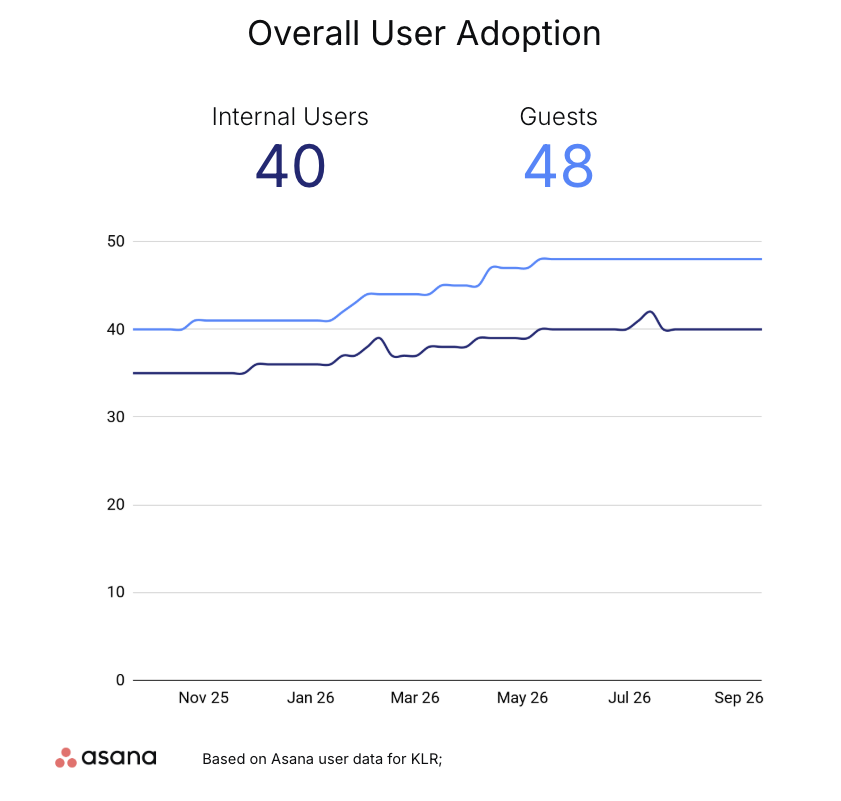
Adoption: every paid seat is in use
Before we started in February, someone at KLR proposed leaving Asana. Seven months later, the company uses every seat it pays for.
Engagement: new work goes into Asana when it starts
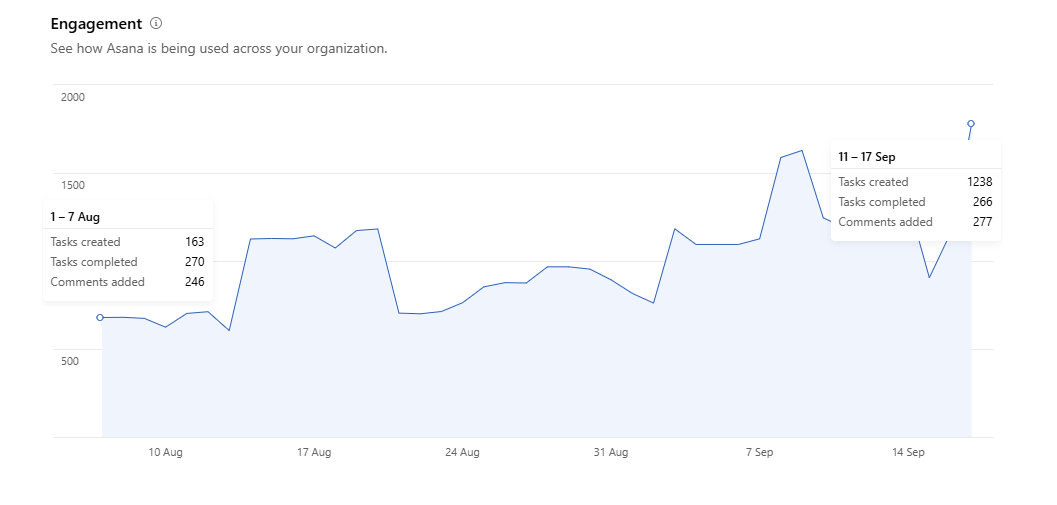
Between early August and mid-September, weekly activity in KLR’s Asana grew roughly two and a half times. Nearly all of that growth is new tasks, as campaigns are set up from the template and the forms add their POS material tasks. Completions held steady through the August holidays.
Work now lands in Asana when it starts, not when someone remembers to log it.
Collaboration: status updates replaced some status meetings
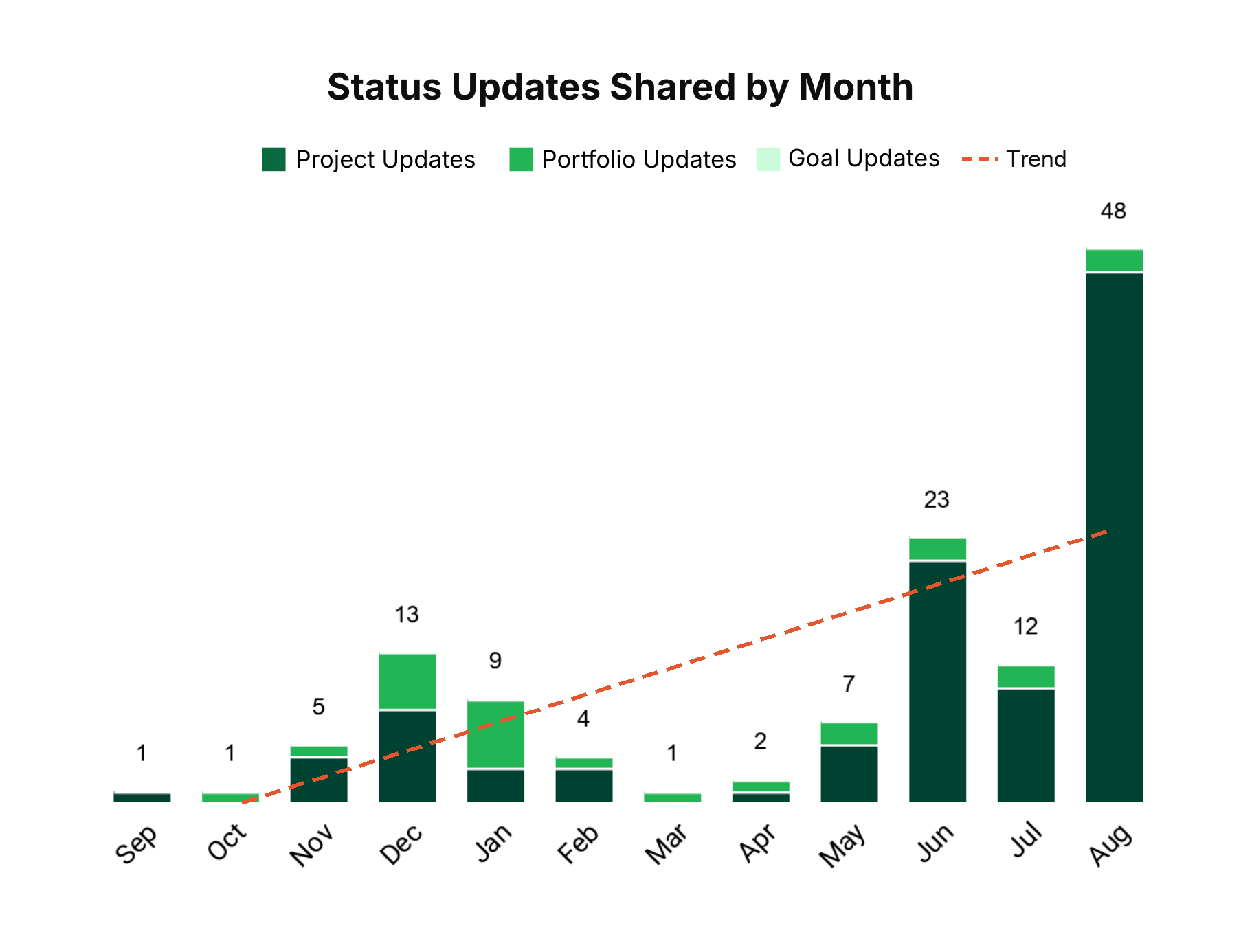
In the three months after Launch Day, KLR posted almost twice as many status updates as in the nine months before it. August alone beat those nine months combined.
This is the fog Sebastjan described in February, lifting. Finding out what a department is doing used to mean calling a meeting. Now it means opening the portfolio.
What’s in it for you?
Four things you can act on this week
- Check the conventions before you replace the tool. KLR was ready to leave Asana. The tool was not the problem. That is the most common expensive mistake we see, and the diagnosis costs a week.
- Keep the Excel. KLR’s product grid and OneDrive file store did not move, on purpose. A system that demands to hold everything gets abandoned by the people who need one file to behave like a file.
- Write down where a decision lives. One sentence – decisions in Asana, discussion in Slack, anything external in email or Teams – moved more than any feature we configured. It costs a meeting.
- Book the follow-up before you launch, not after. This is Sebastjan’s lesson, in his own words, and it is the honest one: what he would have added was “a stronger emphasis on the correct usage of the new process among the team, and a follow up step, after the implementation, for fine tuning.” Going live is the beginning of habit change, not the end of it. Put that stage in the plan at the start, when it is a decision rather than a rescue.
What KLR says
What changed for Sebastjan is not a feature. Now, finding out what others in the company are doing no longer requires a meeting.
“It is really becoming a central source of information that you can rely on,” he said. “So it’s tasks for the people, but then also information about what the company is doing.”
And underneath that, the rule that makes it work – which is about people, not software. Discussion can happen wherever it happens. But: “The decision has to be, and is, in Asana.”
For Marta the shift is different, and it is the one we watch for. She took full ownership. It is not Remote Sensei keeping the system running the way it was designed. It is her – and when a campaign tried to start without the intake form, she was the one who reminded the conventions set. She stopped describing the system as ours.
FAQ
Do you need a new tool if your team is not using the one you have?
Usually the tool is not the problem. KLR Europe had owned Asana for years and had considered leaving it, but what was missing was not a feature – it was a written record of how the company uses it. Four months later, on the same tool, overdue tasks were down 53%.
What actually changed?
Campaigns now start from an updated project template, with POS material tasks added automatically from dedicated forms. Every campaign appears in a single portfolio for leadership. A dedicated column and custom field make blocked work, and the reason for it, easy to find. And the conventions are written down, so decisions live in one place.
What did the team think of it?
Sebastjan Kocjančič and Marta Marga rated the implementation 9.5 out of 10. Seventeen people went live together on Launch Day: Campaign Managers, Sales Managers, the Head of Sales, the Head of Marketing, and the COO.
Does a new way of working stick after go-live?
Not on its own. At KLR Europe, going live on 12 June was where habit change started, not where it ended – the stage that reinforces it, Consolidation of Changes, was outside this engagement’s scope. Their COO named the same gap himself: what he would add is a follow-up step after implementation, for fine tuning.

It was not a new system. We already used Asana.
And when someone says the team is too busy to take this on - stop and ask why everyone is so busy. The whole idea is to make everyone's life easier, so you have to find the time to do it. You should not be so busy that you cannot tackle anything.
 Sebastjan Kocjančič
Chief Operating Officer KLR Europe
Sebastjan Kocjančič
Chief Operating Officer KLR Europe

If it already feels like too much, hire the people you are short of now. That is the short-term answer. The long-term answer is the system, because systems always work and you need them when you are growing.
And this was not someone arriving to give us tutorials on how to click in Asana. The tool was built for us. Barbara listened, and we made it together.
Marta Marga
Head of Marketing KLR Europe

Is it the tool, or the way your team agreed to use it?
KLR nearly left Asana. What they were missing wasn't a new tool, it was instructions nobody had written down.
Answer a few questions. If we can help, you get a free Reliability Diagnostic call.