Claude
 ChatGPT
 Gemini
Building trust in a distributed team isn’t what you know from the office. You don’t see your people every day, yet you still have to hand them tasks and goals and believe they’re giving it everything they’ve got. The good news: trust at work isn’t a personality trait you either have or don’t. It’s a set of specific leadership behaviors you can start using today. So let’s start with the basics…
| What you’ll learn | In short |
|---|---|
| What is trust in a team? | A practical resource you can build faster than you think, not an abstract personality trait. |
| How do trust and accountability work together? | It starts with you as the leader: first you build trust in yourself, then you pass it on to the team. |
| How do you build trust in yourself? | Through integrity, clear intent, capabilities and consistent results, the model from Stephen M.R. Covey. |
| How do you inspire trust in a distributed team? | 11 everyday leadership practices: honesty, clear expectations, owning your mistakes, delivering results. |
| Where do you start building your employees’ trust? | With yourself. Your attitude as a leader is the template the whole team copies. |
What is trust?

Trust is like the air we breathe. When it’s present, nobody really notices. But when it’s absent, everybody notices.
Warren Buffett, business magnate, investor and philanthropist

Trust in a team is a pragmatic, tangible, practical resource you can create. And much faster than you think. Look at how people behave in two different kinds of teams: ones where people trust each other, and ones where they don’t feel they can rely on one another.
Members of teams with low trust and low accountability:
- Hide their weaknesses and mistakes from each other.
- Blame others when things go wrong.
- Hesitate to ask for help or for constructive feedback.
- Don’t deliver on time.
- Resent proactive, engaged teammates.
- Avoid difficult tasks and taking risks.
Members of high-trust teams, who count on each other:
- Admit their weaknesses and mistakes.
- Assume their colleagues mean well.
- Aren’t afraid to ask for help.
- Take the risk of giving constructive feedback.
- Respect teammates who hold themselves to the same high standards.
- Make sure weaker performers feel the pressure to improve.
- Act proactively, without fear of criticism.
Those few differences are worth thinking about. They show how much you can achieve with a team whose members aren’t afraid of their own opinions or of how others will react, because they rely on each other’s objectivity and good intentions. So trust should be a key part of your plan to get your team performing better and more efficiently than it ever did in the office. Which brings us to:
The 5-step secret formula for trust in a remote team
Here’s how the trust and accountability mechanism works:
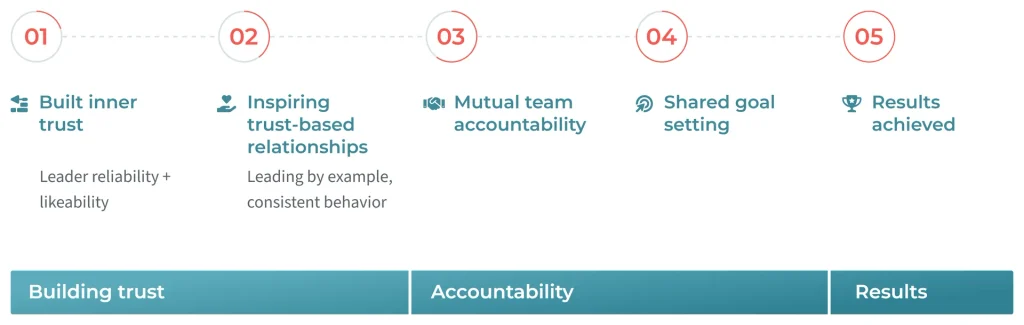
The trust and accountability mechanism
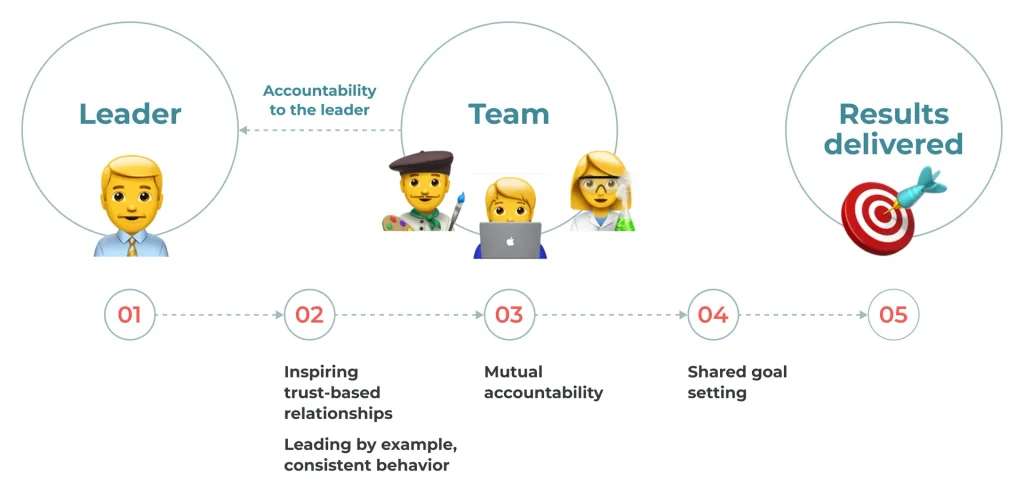
It all starts with you, the leader.
➀ Build inner trust
First, you have to trust yourself. How much you trust yourself comes down to several things, including:
- your skills, and having tested them in practice
- self-awareness: knowing what you’re good at and what you’re not
- your ability to set and reach goals
- keeping your commitments
- your ability to handle criticism
Four core elements make you credible, both to yourself and to others:
- Integrity: do you do what you say?
- Intent: are your intentions clear?
- Capabilities: how well do you know the field you work in?
- Results: what have you actually achieved?
Stephen M.R. Covey put it best, in the form of a tree.
➁ Inspire trust and build trust-based relationships in the team
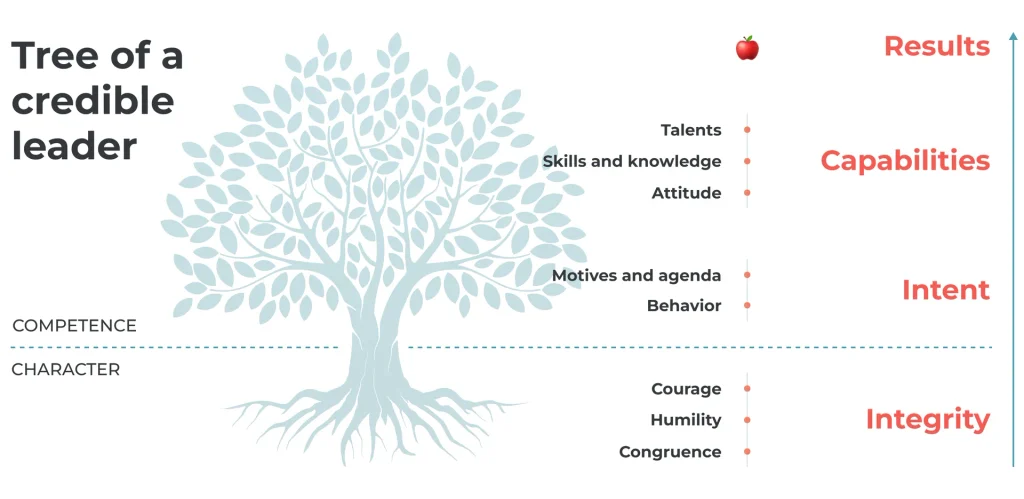
Like the tree above, trust in a distributed team starts at the roots. It’s the roots, not the leaves or the fruit, that decide how strong a leader’s role in the team really is. Stephen M.R. Covey’s model names four cores of credibility: integrity, intent, capabilities and results.
Integrity
Integrity means consistency and courage: acting fully in line with your personal beliefs and values, even when it’s hard. It also means humility. You care more about what’s right than about being right. You don’t cling to your first position. You recognize what other team members bring, because you know it leads to faster decisions. You don’t need the credit. What matters to you is everyone’s well-being and the end result.
How to build integrity:
- Make a habit of making personal commitments to yourself and keeping them. In practice, that probably means making fewer of them, not more. In other words, don’t commit on impulse, and be assertive when others ask things of you.
- Let something bigger guide you, for example a personal mission that says what you want to be known for. You can share it in one of your team’s chat channels or at a team planning meeting. Then live it out through actions that match your values.
Intent
Intent is the foundation of your credibility. Even if you’re honest, have the skills you need and deliver results, people will question your motives and stop believing in what you do if your intent isn’t clear.
The key ingredients of clear intent are:
- Motive: the reason you do one thing and not another. The motive that earns a leader the most trust is acting in the best interest of the rest of the team.
- Direction: clear, easy-to-read intent shows up when your behavior, meaning your thoughts, words and actions, all point in one direction that others can see.
To become more aware of your intentions (which can’t be faked):
- Examine your motives. Stop for a moment and check where your words and actions are really coming from.
- Declare your intentions out loud. Overcommunicating is the baseline in remote work, so people get a real chance to understand what you’re trying to do. You’ll see how well others do just because you’re present, and how your personal credibility grows.
Capabilities
Capabilities inspire trust and build confidence. To stay credible, get ready to keep growing. You have to keep improving your skills and matching them to the work in front of you. How fast you adapt to a new situation is your real test.
You’ll earn credibility by bringing these together:
- Talents: your natural gifts and strengths.
- Skills and knowledge: what you do exceptionally well, thanks to your know-how, awareness, and understanding of people and of your team’s environment.
- Attitude: the way you approach challenges, combined with your personality, will inspire more or less trust in the team.
Credible leaders inspire people instead of forcing them. Show your competence together with your character, and people will follow you.
Results matter
Results give you clout and mark you out as someone who creates value in your organization, not just a good talker. Ask yourself two key questions: What concrete results do I deliver day to day? How do I get them? Great leaders get results in a way that inspires people and builds trust. They create a culture where people feel safe even when they make mistakes while they learn.
So if you want great results as a team, you have to get them collaboratively:
- Take responsibility for your own results first.
- Use your creativity to find the best ways to get the results you want.
- If one approach doesn’t get you there, try something else.
- Expect to win every time, and prepare your team for exactly that: winning.
- If you expect to win and everyone on the team believes in it, you’re actually helping all of you get there.
- Recognize effort, but always show the link between what you’re doing and the goal you’re working toward.
- Start seeing yourself as someone who gets things done.
That’s what credibility rests on, and in the end, trust. These 4 pillars of who you are as a team leader (integrity, clear intent, capabilities, ownership of results) give you a sense of inner trust. When you act in line with yourself and trust yourself, you can simply be present, without constantly overthinking how the world works or how to influence people. Unlocking that feeling as a manager comes easily when your goal is to help others. Honesty, clear intentions, and ownership of results and of the team will make people deeply satisfied to be part of it. That, in turn, means higher performance and shared ownership of the work they’re given.
When you trust yourself, it’s much easier to earn the team’s trust. But what you actually do matters more than what you say. Your behavior is the outward expression of the values we’ve just covered. And if you, as the leader, behave consistently and in line with deeply rooted values, people will trust you. That, in turn, will shape trust among the rest of the team.
Here are 11 good practices for managers in a distributed setup. This list will help you see even more clearly how you affect your team. The distance between you doesn’t matter here. Your people feel your presence, the way you work and how you treat them. And when you act consistently, you set an example and create trust.
- Talk straight and face reality regularly.
- Make your expectations clear.
- Admit you can be wrong, and don’t hide your weak spots.
- Fix your mistakes.
- Stay positive.
- Show loyalty.
- Deliver results.
- Keep getting better.
- Listen first, and show you’re listening.
- Extend trust.
- Own the team’s results.
Talk straight and face reality regularly
The most obvious one, and the hardest to pull off. Saying things straight, however hard that is, works better in the long run than keeping quiet. Once you decide to keep something to yourself, chances are you’ll keep it to yourself for a long time. Honesty puts us in a state of productive discomfort and conflict. Especially when the truth that comes out is inconvenient for us. But honesty brings comfort a moment later. You’re not avoiding reality, and problems get solved fast. Otherwise, you and your team will be working off an unreal picture where mistakes are hidden. Tackle the hard problems and take responsibility. When you say what hasn’t been said yet, people will trust you more and more.
Make your expectations clear
Send clear signals that lock in expectations and shape how people work together. Ask your colleagues open questions to make sure they understand what’s expected of them. To cement your role as the person who helps, use one of these lines:
- Can I help you with ___?
- You can find what you’re looking for in ___.
- Take this one to ___.
- Check the documents in the ____ folder.
Always keep in mind that two people can quickly discuss a goal and walk away with completely different versions of what’s needed. Avoid that by agreeing on what’s realistic, then writing the agreement down. Ideally, you or your team member fill in the description of the task or area of responsibility, depending on who wrote it up first. Don’t use wording that’s open to reinterpretation. You can also break a big goal down into smaller steps together, so you’re sure you fully understand and agree with each other. Clear expectations are one of the foundations of transparent communication in a team. Without it, interpretations drift apart fast.
Admit you can be wrong, and don’t hide your weak spots
In every interaction, we have a natural tendency to hide our weaknesses and come across as competent. That does nothing to build trust in a team. Instead, open up. Show that you make mistakes. Encourage people to speak up in the group chat or on a video call with lines like: “Of course, I could be wrong here.” “What am I missing?” “What do you think?” It’s hard for people to say in front of the team: “I’d like to add something here, but I’m not sure it’s relevant or helpful.” It’s just as hard not to answer when you, the confident leader, ask for their opinion or their help. A sense of connection in a team is also built from small, frequently repeated moments of vulnerability. Nothing gives a team more strength than the moment the leader signals a weakness. According to Dave Cooper, a former Navy SEAL commander, the most important words a leader can say are: “I screwed that up.”
Fix your mistakes
When you get something wrong, admitting it isn’t enough. The hardest part is apologizing and working hard until the situation is fixed. If the problem affects a client, make it up to them with exceptionally good service. People will respect your willingness to put things right almost as much as they admire your confidence and honesty in owning the problem. When you’re ready to fix everything, you show humility and courage in action. You also signal to others that they don’t need to hide their mistakes. That builds a team culture where people openly show their human side, including the fact that they get things wrong. The result is more productive work, because everyone is working from the real, current version of the situation, not the one from a few weeks ago or one distorted by hidden mistakes.
Stay positive
Nobody likes working with people who are always negative and pessimistic. Working in a virtual team can be stressful, so how you react in front of the team at those moments matters. Especially since most of the cues you’d normally pick up from tone and body language get lost in cold text. Remember that laughter isn’t just laughter. It’s the most fundamental sign of safety and connection between people. Always assume the best intentions. A positive attitude (and encouraging others to have one) will make people like each other more. Sometimes a simple emoji reaction to a message in a group or private chat is enough. Sometimes it’s a funny comment, and sometimes a photo of yourself in a ridiculous situation. Adding value this way, you’ll build deeper bonds and good vibes you can actually feel.
Show loyalty
In a remote team that’s just starting out and has no established communication habits, word about who’s responsible for what gets around more slowly. So always give credit publicly to the team members who earned it. Always talk about others as if they were in the conversation. If you ever feel the urge to talk about someone behind their back, have the courage to message them directly, or add them to the chat or video call, and talk through your concerns honestly. With that approach, everyone can be sure their contribution will be respected, whatever happens down the line.
Deliver results
It seems obvious. Your attitude sets the example, so deliver what you promise. Only then do you have the right to expect the same from others. It sounds simple, but it often gets skipped. Managers blame remote work when results come in late, but remote work isn’t the problem. Owning the team’s results is part of smart, effective leadership, whatever the working model. Be proactive about making things happen instead of letting events take their course. That’s your job as a leader. It will take setting precise goals and hitting them on time. Think carefully about what you commit to. Make keeping your commitments part of who you are. Watch out for the trap of breaking a promise and trying to wriggle out of it. When your commitments are written down in a task management system, you and your crew can see exactly what everyone is working on. Use that to build accountability for the word you’ve given others. Get yourself and your team comfortable with a work management tool such as Asana. It’s also the first step toward deliberate delegation in a remote team, and without it, full trust is hard to come by. Setting deadlines everyone can see will push you to act. That way, you’ll set a good example and get the rest of your colleagues more engaged. What’s more, you’ll build trust in a team that now has tangible proof it can rely on you.
Keep getting better
Remote work gives you and your team remarkable room to grow:
- More time to learn. You’re not spending hours stuck in traffic anymore.
- New surroundings, new stimuli, a wider context and a better understanding of the world. Moving your workplace to a new country or city lets you see things from a different angle, without the home-office-home routine.
- A valuable system for sharing formal and informal feedback. When you and your team see feedback as a chance to keep growing, it will come much more often and in a much more approachable form.
Listen first, and show you’re listening
Trust in a team grows at lightning speed once you learn to listen before you speak. Try to understand what your team member is telling you, and only then diagnose problems, with plenty of empathy. In a remote setting you get fewer signals, so you’ll need to show more understanding. Never assume you have all the answers. Ask as many questions as you can and look for explanations. Leadership has little to do with representing the team and managing it, and a lot to do with listening to what your people need and meeting those needs. Use Slack or your group chat for this, and set up a channel just for answering any question at all. Show that you’re actively listening. In text, add emoji reactions. It takes almost no effort and gives a taste of emotional communication. On the phone or on video, keep up a steady stream of affirmations, like “yes”, “uh-huh”, “I see”, which encourage the speaker to keep going. It signals that you’re in sync with the other person and creates a sense of being understood. Avoid interrupting. Smooth turn-taking between speakers is a strong sign of a cohesive, high-performing group. Interruptions break the flow of conversation and people’s sense of belonging. On that note, a good internet connection for everyone on the call matters too. Of course, not every interruption is bad. In creative sessions, for example, team members often interrupt each other in bursts, the leader included, who in that moment is treated as an equal. The key is telling the difference between interruptions born of shared excitement and those rooted in a lack of awareness and empathy.
Extend trust
To earn trust, show you can trust others. When you extend trust, people feel the need to return it. It’s a very powerful mechanism, and in remote work you should actively use it. Fake trust on your side makes people pull their trust back. Examples: you hand people responsibility but don’t give them the permissions or resources to do the job by default, so they have to keep asking you for things just to take the next step toward the goal. Or, once you’ve assigned a task, you keep checking on progress and micromanaging. Give trust generously to those who’ve earned it. Extend it conditionally to those who are still “working on it”. Err on the side of trusting too much rather than giving up on trusting others. Over time, you’ll learn how far to extend trust depending on the situation, the risk, and the character and competence of the people involved.
Own the team’s results
If you want your team to trust you fully, remember that you’re responsible for the group’s end result. Delivering results = trust + accountability. During a project, take on the kind of responsibility you want to see in others. And take it for everything that happens, good and bad. Nothing builds trust in a team like a goal you’ve reached together. When something goes wrong, don’t even think about deflecting onto other people’s duties or pointing fingers. In the end, looking after your results is on you. So whenever that happens, straighten up, take a deep breath and say: “I’m responsible for this.” To keep the momentum going, review yourself and what’s happening in the team every month or every week, looking at where trust is present and where it’s missing. Keep following the principles above, and build trust by inspiring people and extending it further. It’s one of the challenges we tackle in Stages 6-12 of the Reliability Protocol, building the work conventions and everyday habits that trust in a distributed team rests on. And if you want to see where your team stands today, take the short Reliability Diagnostic.
Frequently asked questions
How do you build trust in a team?
Building trust in a distributed team starts with the leader. First you have to trust yourself (integrity, intent, capabilities, results), then consistently apply everyday practices: honesty, clear expectations, owning your mistakes and delivering results.
What is trust in the workplace?
Trust in the workplace is the belief that your colleagues act in good faith, keep their commitments and can be relied on even without constant supervision. In a distributed team, it’s the only substitute for being physically present.
Why does trust in a team matter for results?
Trust in a team means less hiding of mistakes, less blaming and less avoiding difficult tasks, and more proactivity and willingness to give constructive feedback. That translates directly into higher performance and better results.
What is the leader’s role in building trust in a team?
The leader’s role is key. The leader has to earn the team’s trust first, then model the behavior (honesty, transparency, ownership of results) that the team will naturally start to copy.
What are the signs of low trust in a team?
Low trust in a team shows up as people hiding their weaknesses and mistakes, blaming others when things go wrong, avoiding difficult tasks, and being reluctant to ask for help or give constructive feedback.
How long does it take to build trust in a remote team?
You can build trust in a remote team much faster than you’d think. It’s a concrete, practical resource built on repeatable leadership behaviors, not a trait you have to wait months for.