
 Claude
 ChatGPT
 Gemini
Wondering why your people don’t carry out your instructions? It’s certainly not because they can’t, aren’t engaged, don’t feel responsible for the team’s success or are simply ignoring you. They just struggle to understand what you expect of them. And as a leader, it’s on you to hand instructions over properly and make sure they can only be understood one way. This guide shows you how to delegate tasks in a remote team so they get done 100% of the time, whether you’re delegating in a software house, an agency or a language school.
| In short | |
|---|---|
| Where do you start with delegation? | Before you hand over a task, pin down the result you expect: the data, the format, the number of versions. |
| How do you hand over tasks in a remote team? | Ideally on a video call, then write up what you agreed within 10 minutes in a tool like Asana. |
| How should you phrase instructions? | “Could you…” and “Please…” soften the tone without weakening the instruction itself. |
| How do you set deadlines? | Always a specific day and date (sometimes a time), agreed with the person doing the work, and realistic. |
| What makes instructions more likely to get done? | The word “because”. Backing a task with a real reason makes it much more likely to get done. |
How to delegate tasks: first, know what you want
Effective delegation starts with pinning down exactly what you expect, before you hand anything over. Think that’s obvious? It only looks that way. Plenty of misunderstandings start right at the beginning, at the moment you delegate.

So before you hand over a task, always ask yourself what you actually expect. For example:
- what data you’re expecting,
- which analyses and reports you need,
- how many versions of a flyer, a piece of copy and so on you need.
These are just a few examples. You can apply the same thinking to any situation and any request you make.
Delegate in real time, with work management tools behind you
Delegating in real time, in a live conversation, gives you the best chance that your instruction is understood correctly. In a remote team, face-to-face meetings are rare or simply impossible, so delegate over video calls or video conferences. When you talk to someone directly, you’re working with more than words: body language and tone of voice can add real weight to your request. You also get the chance to confirm that the person has understood exactly what you’re asking for.

Instructions given in a live conversation have the best chance of being carried out properly and on time. On one condition…
Write up what you agreed within 10 minutes
Memory lets you down, and spoken words fade into thin air. So within 10 minutes of the meeting ending, before you even get up from your computer, write up what you agreed and send it. The best place for this is a work and project management tool such as Asana: create a separate task and assign it to a specific person. When you delegate this way:
- Make the title clear and outcome-based, so it shows the end result. “Blog article written” is a better title than “Blog article”.
- Set a precise deadline.
- Assign one owner (only one, so responsibility doesn’t get diluted).
- Give the context.
- Attach the files.
- Add everyone who should know about the task as a collaborator.
In the Reliability Protocol, we work on standards like these for writing up tasks in Stages 6-12, as we build the foundations of a reliable team.

If your team still runs its communication through email rather than on the rules of asynchronous communication, send an email. But do it properly. What does that look like?
Delegating by email: keep it short, to the point and… complete
The rules for delegating by email are the same as in Asana. Be concise: say in a few words what you expect. Give the details: cover every element you care about. Include what’s needed: if the work needs extra data that you have, attach all the files to the email or to the Asana task.

- Make sure the person has everything they need to do the task. Ask them if there’s anything else they need.
- Make sure they’ve understood the instruction. Ask for feedback. In Asana this is easier, because with one button they can ask for more information or accept the task.
Two phrases that set you up for success
The two phrases that do the most to make your instructions effective are “Could you…” and “Please…”. Being the leader doesn’t excuse you from using the right language. Using your position to bark orders like a drill sergeant will only turn people against you. The ones with a rebellious streak may even push back without realizing it. Military-style lines like “Get this done for me by Friday” or “Have this ready for tomorrow” can backfire. You’re the leader, so your people will know these polite words are really instructions. That’s how our professional work culture works. But because they sound softer:
- you put yourself on a level with your people,
- you show them respect,
- you build good relationships between manager and team.
With these phrases, people become more willing to do the work the way you asked and in the time you set. Speaking of time…
How to give instructions: the hard art of setting deadlines
A precise deadline is non-negotiable. Without one, delegating is pointless. The deadlines you set need a few specific qualities.
Be painfully precise
Don’t set deadlines in weeks, e.g. “Please have this ready for me in week 34.” Do that and you can be almost 100% sure the task will land on Friday. If you’re lucky, you’ll get the data before noon. If you’re not, it’ll be in the afternoon or, worse, on Sunday. Many people working hybrid or remote stretch their working time into the weekend, so for them the week ends on Sunday. How do you avoid this? When you delegate in a hybrid or remote team, always finish with an exact deadline, as precise as you can make it. A day and a date are an absolute must. In some cases you can add a time as well.
Don’t expect the impossible
Deadlines have to take every factor into account. That’s the only way they’ll be realistic. If a task takes a week, don’t set it for tomorrow. The deadline will be missed anyway, and all you’ll create is unnecessary pressure and stress.

Not sure what deadline is realistic for a task?
Be honest.
Talk it through with the person who’ll own it and agree on the best option together. That’s how you make sure the deadline holds. A person who had a say in the deadline will do everything they can to meet it.
Before that conversation, also check:
- How many tasks the person has coming up. Asana’s Workload feature helps you here;
- Your priorities, and what could be pushed back if needed.

You can also make the opposite mistake when you delegate: not underestimating the time a task needs, but overestimating it. Give someone a week for work that really takes a day, and you can be sure you’ll get the result exactly… at the end of the week. Not a minute sooner. Why does that happen? Parkinson’s law.
Parkinson’s law, first published in 1955, hasn’t aged a day: work expands to fill the time available for its completion. Parkinson showed time and again that a task takes exactly as long as the time you give it. If a report only needs data pulled from, say, Asana, which takes a moment, but the deadline is the next day, that’s exactly when you’ll get it. So before you give an instruction, stop and think through the situation and all its parameters. Only then will the deadline be realistic and the task get done. Work and project management tools like Asana are a great help here. Asana lets you set an end date and, in its more advanced plans, the whole period the task runs over. It takes one click. Timeline view, one of Asana’s features, makes it easier to coordinate lots of tasks and also shows how busy each person is, so you can actually manage their work and shape the productivity of the whole team.
The magic word that makes delegation work
The magic word that makes delegation more effective is “BECAUSE”. As a child, you were taught to say “thank you” and “sorry”, but this time those aren’t the words that make the difference. If you want your instruction carried out, explain why it matters. In the late 1970s, a famous experiment known as the Xerox study set out to find whether there’s a best way to cut in line at a photocopier. It used three requests (with different people at different times):
- “Excuse me, I have five pages. May I use the Xerox machine, because I’m in a rush?”
- “Excuse me, I have five pages. May I use the Xerox machine?”
- “Excuse me, I have five pages. May I use the Xerox machine, because I have to make copies?”
The results may surprise you:
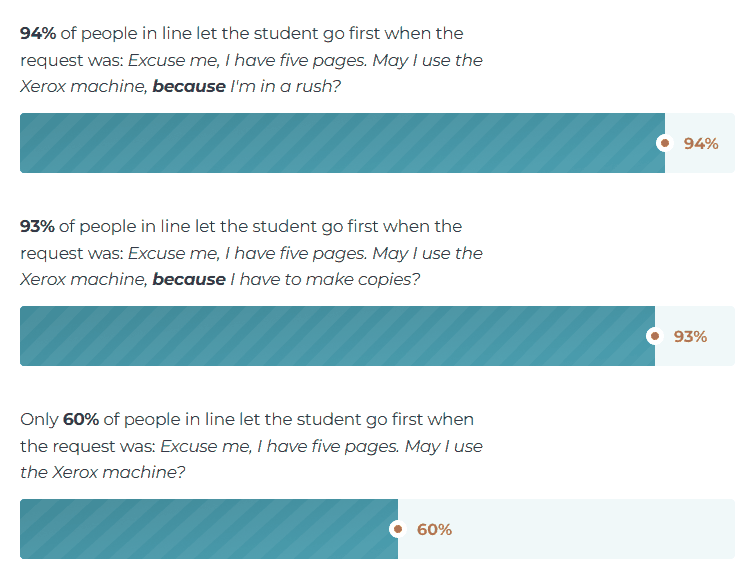
What does this study mean for you? A lot. It showed that what swayed people wasn’t the reason, but the single word “because”. Use “because” consistently to grow your influence on your virtual team: in emails, chat, project management systems like Asana, in meetings and in voice messages. You’ll bring clarity to your communication and give your people the knowledge they need. With it, they’ll understand how important their role is in your organization. But remember… Unlike the study, give real reasons and facts. Build your relationships in the team on them. That’s the only way you, and your instructions, will be taken seriously.
And if you want to check how reliably your team works today, take the Reliability Diagnostic. In a few minutes you’ll see where delegation in your team most often gets lost.
Frequently asked questions
How do you delegate tasks in a remote team?
Define the result you expect precisely, hand the task over ideally on a video call, and within 10 minutes write up what you agreed in a work management tool such as Asana, with an outcome-based title, a deadline and a single owner.
Why don’t employees carry out instructions?
Most often because they don’t understand exactly what the leader expects, not because they lack commitment. Making the instruction unambiguous and confirming it’s been understood is the job of the person delegating.
How do you set a deadline when delegating tasks?
Always give a specific day and date (and a time if needed), and agree the deadline with the person responsible, taking their workload into account.
What is Parkinson’s law in delegation?
Parkinson’s law (1955) says that work expands to fill the time available for its completion. That’s why a deadline set too far out stretches even simple tasks.
What phrases should you use when giving instructions?
The most effective are the polite “Could you…” and “Please…”, plus the word “because”, which backs the instruction with a real reason and makes it more likely to get done.
What tool should you use to delegate tasks in a distributed team?
Work management tools such as Asana work well: they let you assign a task to one person, set a deadline, add context and files, and ask for confirmation that the instruction was understood.


