Claude
 ChatGPT
 Gemini
Do you feel you spend too much time checking up on your remote or hybrid team?
Do you get the sense that without you watching, people lose track of priorities, or just care less?
Can you see that the ways of managing you’ve relied on so far don’t work anymore? Your people can’t see where the organization is heading, and your frustration keeps growing.
Time for a change!
Remote and hybrid work need a completely different work culture from the one you’ve probably known so far. Change is hard, especially if at least some of your people built their habits in a traditional office. You’ll be changing deeply rooted routines.
And the mindset shift isn’t only for your team. It’s for you too. Like them, you have a task ahead of you: to break out of the usual rules and habits.
Today we’ll walk you through the elements you can’t build a high-performing remote team without. Skip them and you’ll end up with chaos, pressure and stress that will wear all of you down.
| In short | |
|---|---|
| Flexible working hours | Accepting different working hours and chronotypes raises engagement and team performance. |
| A shared team calendar | 3-4 shared hours a day and one calendar give you oversight without taking flexibility away. |
| Protection from overwork | Watching each person’s workload keeps engagement from turning into burnout. | Delegating responsibility | A two-stage handover process builds engagement and takes weight off the leader. |
| Equal access to tools and files | Everyone finds what they need on their own, without asking the leader or a colleague. | An open door and transparency | Clear availability rules and transparent communication build trust in a distributed team. |
Macromanagement vs micromanagement: the foundation of remote team culture
Micromanagement is about getting today’s tasks done. For a leader, that means constant checking and supervision. That’s where most of your attention goes, and that’s what eats most of your working time. But focusing on one step after another has one serious side effect. The bigger goals get lost. The organization’s mission and strategy fade from view. That’s why your organizational culture needs to change. Especially in businesses built on remote or hybrid work, where priorities blur easily. The change is macromanagement. You give people more freedom. You hand part of the responsibility over to them. You respect their time and habits and trust them to deliver by the agreed deadlines. Over time, trust turns into certainty. You, meanwhile, keep the organization’s mission and goals in sight. With less checking to do, you can focus on them, analyze them and look for new ways to reach them. You look at the whole board, not a single square. It’s a bit like chess. You read the game backwards: from the goal, through the moves that lead you there, and you never lose sight of it.

If you switch fully to managing at the macro level, you’ll get: more engaged people; higher performance from each person and from the whole team; a sense of shared ownership and agency in every team member; happier people and lower turnover; extra time for other high-priority work. What follows is a short guide to making that switch. Put these six rules in place and you’ll see your role as a leader in a completely different way. A new work culture takes hard habit changes, from you and from your people. So you don’t have to roll everything out at once. Break stereotypes and old patterns slowly. Move on to the next stage only when the previous one is fully in place. That makes the new culture easier on everyone. This guide will take you through a complete change in how you see work. Let’s start.
Accept that not everyone works 9 to 5
Around 35% of remote workers in Poland say flexible working hours are one of the biggest advantages of remote work.

Flexible hours let work fit smoothly into the daily routine, yours and your family’s. Going for a walk is no problem, and neither is cooking lunch, walking the dog or taking the kids to school or kindergarten.
Each of your people also has their own body clock. Some like to get up at dawn, others do their best work in the middle of the night. Being able to work with your chronotype beats anything the office has to offer.

In remote work, what counts is the task. It doesn’t matter what hours people work. What matters is that they deliver by the deadlines agreed up front. The culture of high-performing remote teams rests on accepting this. So show respect and understanding for how your people work. And go further. Use your team’s different working hours so that instead of a burden, they become your biggest advantage. Let people work at night, and don’t wake them up early in the morning if that’s how they work. They’ll get more done by working when their brain is at its sharpest. But… There’s always a “but”. You’re a team, after all, and sometimes you have to work together. So…
Create a shared team calendar
A shared team calendar shows you who is working and when, without taking away the flexibility of hours. Flexible hours give your people a sense of freedom and independence. But you work as a team, and you shouldn’t lose track of what’s going on. Now more than ever, you need to know who’s working on what and when they’re available. What’s more, whatever people’s family situation, habits or chronotype, agree on shared working hours each day. Usually 3-4 hours is enough to lift the team’s performance. That’s the time when, just like in an office, everyone is working “in one place”.
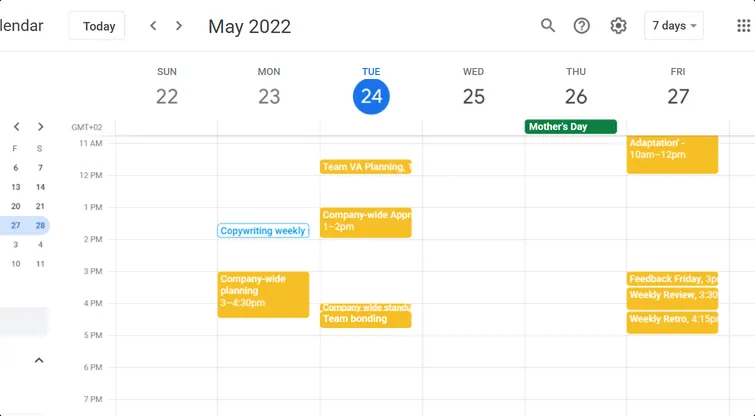
All of this belongs in your shared work calendar. Make it part of your work culture. It helps set a new order by making each team member’s habits and ways of working clear to everyone.
You’ll also avoid conflicts between team members, and between the leader and the team. These conflicts often come from feedback that doesn’t arrive right away, or from people who can’t be reached. A shared work calendar makes it clear when you can expect an answer.
And that’s not all.
It also makes onboarding new people easier. With it, they get to know the rest of the team and how everyone works faster. You’ll avoid misunderstandings, and you’ll avoid new people stalling or losing heart because they misread a slow reply from their new colleagues.
Your shared work calendar should also make room for:
- standups: short weekly planning meetings, either with whole teams or one-on-one, depending on the topic and how much the tasks overlap;
- regular contact with your people: as a leader, you can’t underestimate 1:1s, both the ones that review the work and the more informal ones where you check on each person’s mood, engagement and satisfaction; remember that a bad relationship with the boss is one of the top reasons people change jobs;
- online team bonding;
- each team member’s most productive hours, kept up to date.
That way you’ll have a clear view of how your team works, and the peace of mind to focus on what matters.
Your shared work calendar should lead you straight to the next key element of a high-performing remote team’s work culture.
This may surprise you, but…
Don’t let people work too much
After switching to remote work, people spend 2 hours a day more on work than they did in the office. They often check email or tools like Asana or Slack while still in bed. That usually comes from working in smaller blocks of time spread across the whole day.
There’s also no clear moment when work ends, like switching off the computer.
Glad they’re so engaged?
Wrong!
Constant overtime is a quick, direct route to burnout.

A tired, overloaded employee eventually stops performing, and their focus drops. That breeds frustration, lower engagement and even procrastination. Simple tasks start taking far longer.
The mind needs to recover. Both daily, through sleep, walks, meditation or exercise, and periodically, through holidays and free weekends.
There’s one more thing that matters.
Remote workers, especially those working from home, struggle to separate work from private life. They check Slack while playing with their kids in the afternoon, and they’re in work management platforms like Asana while cooking dinner.
The result?
As many as 47% of remote workers in Poland say work and private life bleeding into each other is the biggest downside of remote work.

Help them change that.
Encourage rest.
But kind words and understanding aren’t the only things you can do.
Check how many tasks each person has on their plate, because that may be where the problem starts.
How?
Use work management tools like Asana. Workload is an Asana feature that shows how much work each person has. Keep an eye on it over time and you’ll see whether someone is overloaded.
The sooner you react, the better. You’ll nip the problem in the bud, and at the same time build a reputation as a leader who looks after the team, understands their needs and manages at the macro level.
Changing your organizational culture doesn’t have to mean less oversight of your people’s performance and engagement, let alone less understanding of their situation.
Hand part of the responsibility to your people
As many as 24% of remote workers value being able to focus on their tasks, and 27% see their efficiency go up.

Use that. Hand part of the responsibility over to them. Deliberate task delegation is one of the pillars of changing your organizational culture. Trust them. Do that and you’ll get a more engaged team that feels part of the whole. Like any change, it’s a process, and it takes time, from you and from everyone else. Split it into two stages:
Stage 1
Make a list of the people you work with and, for each of them, answer these questions:
Why?
- What skills and knowledge do they have?
- What can they take on?
- What results do they get?
How?
- How do they contribute to the company’s mission?
- What problems could come up while they coordinate the whole area?
- What has to change for them to coordinate the whole area?
- What tools do they need to coordinate the area?
What?
- What is their current area?
- What tasks do they do?
Answer each of these and you’ll have a clear profile of the areas your team members work in.
Wherever you see a big share of yourself and a need for too much control, take steps to step back. Use the fact that 27% of remote workers see their efficiency go up after moving to remote work.
Remember: when you step back, the other side steps up. That’s what a real change in work culture looks like.

Stage 2
Start by talking to the people you want to give more responsibility.
- Share your answers from Stage 1.
- Tell them why you want to widen their responsibility. Show what you both gain from the change
- Go through the new situation together with them and think about the answers to these questions
- How would you feel about taking more ownership of your area?
- What has to change for you to take over the area fully?
- Do your current arrangements and working conditions feel fair to you given the wider responsibility?
- Do you need an extra course or training?
- Will more responsibility be stressful for you?
This gives you a strategy for rolling out the wider responsibility:
- Taking the answers to the questions above into account, prepare a clear onboarding process and run it yourself.
- Spell out what you expect.
- Set up regular contact at the start of the change. It will be important support for your people.
Remember, too, that this kind of culture change needs transparency. Before you make someone responsible for coordinating a task, make sure your people have the knowledge they need. That means checking that the team: knows what your goals are; understands what happens if tasks or projects aren’t done on time; has all the information needed for both individual steps and larger projects. At first you’ll want to check on and supervise how the new role is going. It’s your habit, after all. Work on dropping it. By giving people in your team more responsibility, you win back valuable time. Spend it on what matters most in your work ecosystem. You already know that internal processes and long-term thinking both matter a great deal. Think about where to put your attention.
Give everyone the same access to tools and files
Equal access to tools and files means everyone on the team can find what they need on their own, without asking the leader or a colleague. You want to stop constantly checking on people. You want them to be independent and, at the same time, work as a strong, high-performing team. So you have to aim for a setup where every one of you has equal access to data and tools. In an office, that’s not so hard. In distributed teams, it becomes a challenge. Use digital tools to meet it.

Bring in tools for managing projects, work and tasks, plus platforms for asynchronous communication. Put files, comments and instructions there. Let these tools become your fortress and your main command center. Give everyone equal access to them. That way you’ll avoid wrong decisions and wrong moves. Don’t forget onboarding. A new team member has to be trained and ready to use the tools you work with. That shortens their ramp-up time and gets them working productively sooner.
Keep your door open
An open-door policy in a remote team means your people know they can come to you about anything, even though you don’t see each other in person. Right now, when you’re out of reach (at least physically), your people need to know even more clearly that you’re there for them. Make sure they know that: you’ll always listen; they can come to you about anything; you’re there to help them solve problems; you believe in transparent communication. Your door should always be open to them.

Well, almost always… You need a healthy balance between work and private life too. So how do you handle this sensibly? Set clear rules: tell people when you’re fully available and when you’re not; set “open communication” hours, making it clear that during that time you’re ready to talk; always sum up what you’ve heard from the other person; end conversations with a solution; keep up with messages from your team. An open-door policy is also part of a work culture that builds trust between the leader and the team. In a remote team, it takes a lot more work. It matters just as much as digital transformation with project management and asynchronous communication tools. Those help you organize your own time and the whole team’s. The new team habits, on the other hand, build your mutual trust, your engagement in projects and your performance. That’s why digital transformation has to work on several levels and change both of these areas at once. That’s what guarantees your success. It’s one of the challenges we tackle in Stages 6-12 of the Reliability Protocol, building work conventions and making new team habits stick for good. If you want to see where your team stands today on changing its organizational culture, take the short Reliability Diagnostic.
Frequently asked questions
What is organizational culture change in a remote team?
Organizational culture change in a remote team is the move from micromanagement and constant checking to macromanagement built on trust, clear goals and more independence for your people.
What is organizational culture?
Organizational culture is the set of values, norms and everyday practices that shape how a team works and makes decisions. In a remote team, it’s built mainly through communication rules, how responsibility is delegated and how flexible working hours are.
What are the culture rules of a high-performing remote team?
The key rules are: accepting different working hours, a shared team calendar, protecting people from overwork, delegating responsibility, equal access to tools and information, and an open-door policy.
How is macromanagement different from micromanagement?
Micromanagement focuses on controlling day-to-day tasks, and macromanagement on goals and results. The leader gives people more freedom and responsibility and trusts them to deliver by the agreed deadline.
How do you set up a shared team calendar for remote work?
Agree on 3-4 shared working hours a day, add standups, 1:1s and team-bonding sessions to the calendar, and keep the rest of the time flexible to fit each person’s chronotype.
How do you delegate responsibility safely to remote employees?
Start by looking at each person’s skills and area of work, then talk to them about taking on more responsibility, and together agree on a rollout plan and regular contact at the start.
What is an open-door policy in a distributed team?
It’s a clear statement of when the leader is available: telling people your fully available hours, a slot for “open communication”, and the habit of ending conversations with a concrete solution, even without meeting in person.